

Helicopter booking engine: how it works for an operator, from seat to manifest
By AnyInfraTech Team ·
If you sell helicopter seats in the Char Dham season, you know where the day goes. Phones ring, WhatsApp fills up, someone checks a register to see how many seats are left on the first sortie, and a passenger turns up at the helipad heavier than the form said. A helicopter booking engine is the software that takes that work off the phone and puts it in one place.
We built and run BookHelicopter, a multi-operator marketplace for helicopter seats, yatra packages and private charters in India. This guide explains how a booking engine works from the operator's side, what each part should do, and what to ask before you pick a vendor or get one built.
What a helicopter booking engine does
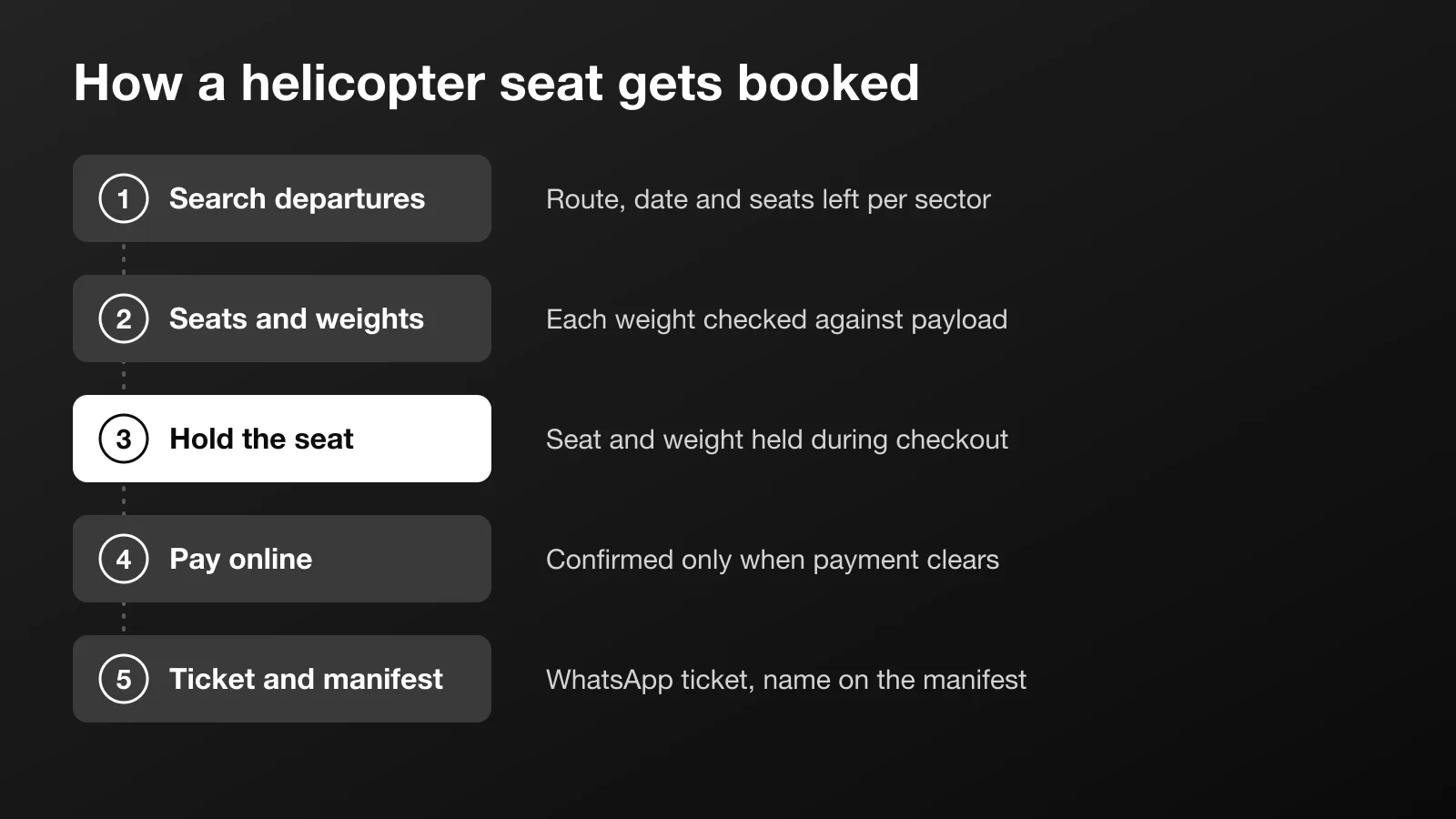
It is the part of your website that sells seats and issues tickets. A customer picks a route and date, sees departures with seats left, enters each passenger's name and weight, pays, and gets a ticket on WhatsApp and email. Your team sees the booking in a dashboard, along with the passenger manifest for every departure.
That sounds like any travel booking site. Helicopters bring three problems a bus or hotel engine doesn't have, though:
- Seats are tied to a departure and a sector, not only a date.
- Weight matters as much as seat count.
- The weather decides whether you fly at all.
Most of what follows comes back to those three.
Departures and seat inventory per sector
Inventory in helicopter ticketing software is not "seats on a date". It is seats on a departure, on a sector. A shuttle route can have an up leg and a down leg, and a yatra route can have several stops. A seat sold on one leg is not automatically taken, or free, on another.
A good engine lets your team:
- Create departures by route, date and time, with the aircraft assigned
- Set seats per sector, so a return seat and a one-way seat are counted correctly
- Close or reopen a departure in one click when plans change
- See seats sold, held and free for every departure on one screen
If a helicopter booking engine only knows "date and number of seats", you will end up keeping the real inventory in a sheet on the side. That is the exact thing you were trying to stop.
Passenger weight and payload per aircraft
This is where the software earns its keep. Each passenger enters their weight at booking. The engine adds it up against the payload you set for that aircraft and sector, and stops a booking that would go over.
On many mountain routes the aircraft reaches its weight limit before it runs out of seats, and the usable payload changes with altitude and temperature. If the website only counts seats, your ground staff find out at the helipad. Someone gets moved to a later flight, away from their family, and you spend the morning apologising.
Check that:
- Weight is collected for each passenger, not once per booking
- Payload can be set per aircraft and per sector
- Your operations team can change it during the season without calling a developer
- Baggage rules are shown before payment, not after
- The manifest shows total weight for each departure
Keep the payload figure in the hands of your pilots and operations team. They know the right number on a given day. The software should simply enforce it.
Holding the seat until payment clears
Between "book now" and "payment successful" there is a gap. It might be a minute. It might be ten if the customer's UPI app misbehaves. If the seat isn't held during that gap, two people can pay for the last seat.
The engine should put a short hold on the seat, and its weight, when checkout starts. If payment fails or times out, the hold is released by itself. The seat is confirmed only when the payment gateway confirms the money. On our builds Indian payments and refunds both run through Razorpay, so the money trail for each booking stays in one place.
Weather cancellations, rebooking and refunds
In the hills, a cancelled morning is part of the season. What separates a calm office from a chaotic one is whether a cancelled departure starts a process or a hundred phone calls.
The flow we settled on after running BookHelicopter through the season:
- Your team marks a departure as cancelled or moved in the dashboard.
- Every passenger on it gets a WhatsApp and email update straight away.
- The message offers only the options you allow, usually a later departure or a refund.
- Rebooked passengers move to the new departure's manifest, weights included.
- Refunds go back through the payment gateway and are logged against the booking.
Write your cancellation and refund policy before the engine is built, in plain words, because the software will follow it to the letter. Any grey area in the policy ends up on the phone.
Charters are quote requests, not a fixed price
Private charters don't fit a price-per-seat screen. The cost depends on the route, the aircraft, the dates, positioning and how long the aircraft waits. One published charter rate is usually too high for some routes and a loss on others.
So treat a charter as an enquiry. The customer sends the route, dates, number of passengers and rough weights. Your team prices it and sends a written quote from the dashboard. Once the customer accepts, they pay online like any other booking. This is how charters work on BookHelicopter, and it keeps the pricing decision with the people who know the costs.
Manifests and the operations dashboard
The manifest is what the ground team works from on the day. For each departure it should list every passenger's name, weight, phone number and booking reference, plus ID details if you collect them, with the total weight at the bottom. It should print cleanly and also be readable on a phone at the helipad.
Around it, the dashboard covers departures, bookings, payments and refunds. If you sell Char Dham or Do Dham helicopter yatra packages, those bookings belong here too. Operators who also run short joyrides can use the same helicopter tours booking software for them: a joyride is just a short departure with its own seats and payload.
WhatsApp confirmations and reminders
Most passengers will look for their ticket on WhatsApp before they think of email. With the official WhatsApp Business API, each passenger gets the ticket, reporting time and helipad details as a message they can show at the counter. A reminder goes the day before, and an update goes out if anything changes.
These messages use templates that Meta has to approve, so write and submit them well before the season opens. We set this up on auton8n, our WhatsApp Business API platform, as part of our WhatsApp marketing and automation work.
What to ask a vendor before you sign
Take this into your first call with any helicopter booking engine vendor:
| Question | A good answer sounds like |
|---|---|
| How is inventory stored? | Seats per departure and per sector, not per date |
| How are weights handled? | Per passenger, checked against payload per aircraft and sector |
| What happens during payment? | Seat held, released on failure or timeout |
| How do weather cancellations work? | Cancel or move a departure, with WhatsApp and email to every passenger |
| How are refunds handled? | Through the payment gateway, logged on the booking |
| Can we take charter enquiries? | An enquiry form, and a written quote sent from the dashboard |
| Who owns the code and data? | You do, in your own repository and database |
| What does support look like in peak weeks? | A named person and agreed response times |
Also ask whether they run a booking site themselves. A team that has sat through a cancelled morning with a full manifest knows things a demo won't show you.
What decides the cost
We don't publish prices, because scope varies a lot from one operator to the next. The main drivers are the number of routes and aircraft, whether you need yatra packages and charters as well as seats, which payment gateways you need (Indian only, or international too), how many WhatsApp templates, and whether you want an app or a mobile website is enough. A proper quote lists each of these as its own line, with hosting and support shown separately. Ask for one in writing and compare like with like.
Next step
If you fly helicopters and want your own booking website, we build it on the same stack as BookHelicopter, with your brand, routes and prices on your own domain, and you own the code. See our helicopter booking engine and ticketing software page, or send us your routes and we will reply with a plan and a quote.

 WhatsApp