

Tourism marketing agency or in-house team? How a travel company should split the work
By AnyInfraTech Team · · Updated 18 Nov 2026

Most travel companies we talk to have already tried one side of this. Either a nephew who "knows Instagram" ran the pages for a year, or a tourism marketing agency ran ads for a few months and the owner never quite knew what came of it. Both setups can work. Both also fail in ways you can predict.
This guide is for owners of tour operators, travel agencies and DMCs deciding who should do which part of their marketing: an outside agency, people on your own payroll, or a mix of the two. We are an agency, so read it with that in mind. We will be straight about the jobs we think you should keep.
Three ways to set it up
All in-house. You hire a marketing executive or two, maybe a designer, and they handle the website, posts, ads and enquiries. You control everything, and you pay salaries every month, in season and out of it.
All agency. A travel digital marketing agency runs the ads, SEO, content and reports. Your team only handles calls and bookings.
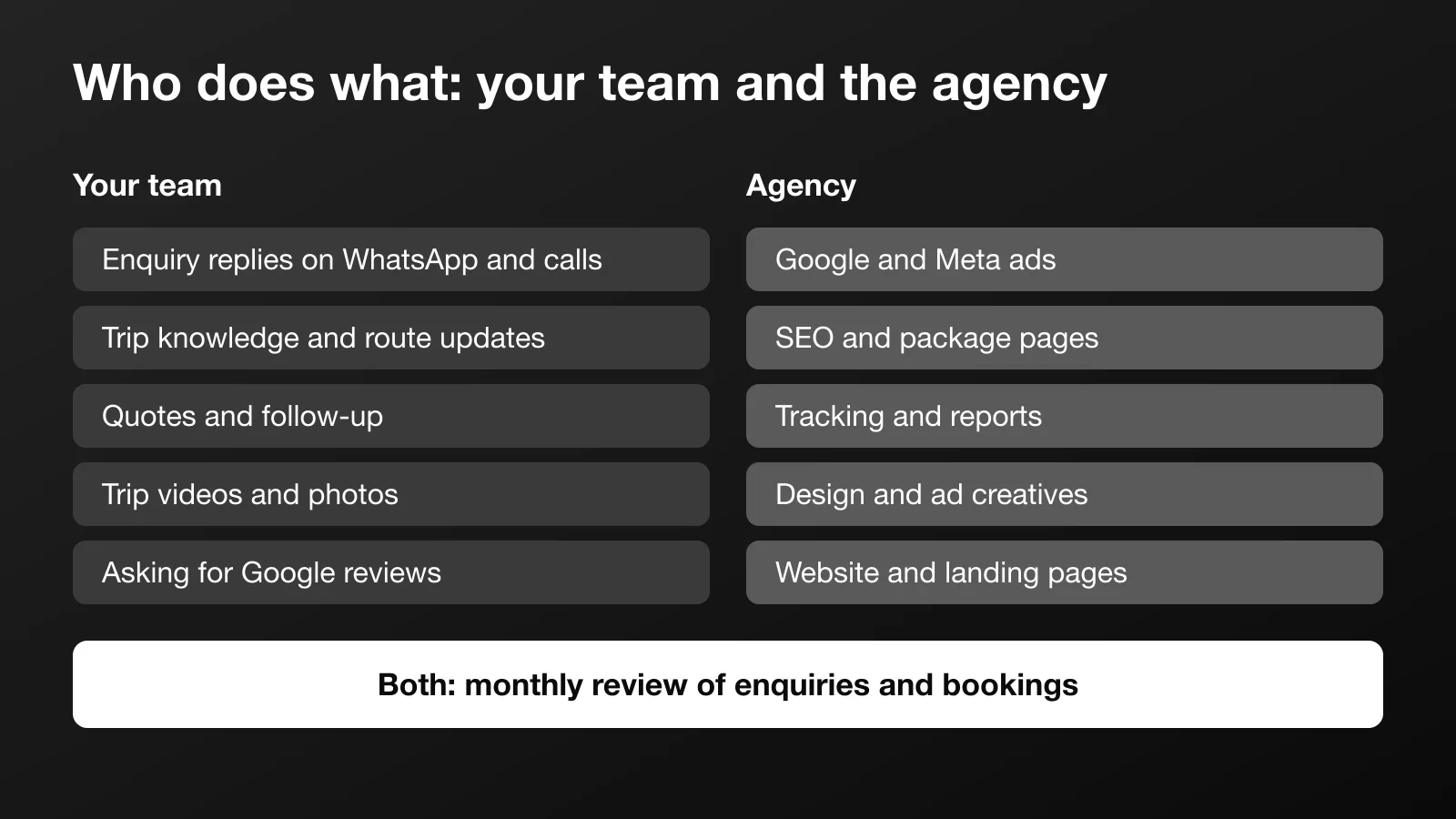
A mix. Your staff own trip knowledge, replies and everyday content. The agency owns the specialist work that needs tools, practice and experience across many accounts.
Most small and mid-sized travel companies end up with the mix, often after trying one of the other two first.
Jobs your own team should keep
Some work is hard to hand over, because it depends on knowing your trips and customers better than anyone outside can.
- Replying to enquiries. The first reply on WhatsApp or a call should come from someone who can answer "is the Kedarnath helicopter fine for my 70-year-old mother" without checking with anyone. Reply speed decides more bookings than most marketing does.
- Trip knowledge. Road conditions, which hotel in Guptkashi has reliable hot water, how long Joshimath to Badrinath takes after rain. An agency can write it up well, but your team has to supply it.
- Quotes and follow-up. Pricing, revisions, the nudge on day 2 and day 5. This is sales, and it should sit with sales.
- Raw content from trips. Phone videos from the guide, driver or tour leader, group photos, customer voice notes shared with permission. Nobody sitting at an agency desk can shoot this for you.
- Reviews. Asking a happy family for a Google review is a five-minute job for the person who travelled with them.
Jobs a tourism marketing agency does better
Other work rewards practice, paid tools and people who do it every day.
- Google and Meta ads. Campaign structure, negative keywords, bidding, creative testing, season budgets. Someone running ads for one company sees one set of results. An agency sees many accounts across many seasons.
- SEO. Technical fixes, page structure, long-tail keyword research, internal links, and the patience to keep at it for months.
- Tracking. Conversion tracking on forms, calls and WhatsApp clicks, UTM tags on every link, and a report that ties spend to enquiries. Many in-house setups we audit are missing part of this.
- Design. Ad creatives, landing pages, brochures and a consistent look. A good designer is hard to keep busy full time in a small travel company.
- Website and landing pages. Page speed, mobile layout, and forms that drop straight into your CRM.
How the costs compare
We won't put numbers here, because they change with city, seniority and scope. What we can describe is how each kind of cost behaves.
| In-house team | Agency | Mix | |
|---|---|---|---|
| What you pay for | Salaries, plus tools, software seats and training | A monthly retainer or project fee, with ad spend paid separately | A smaller team plus a narrower retainer |
| Off-season | Salaries continue when enquiries drop | Scope can often be reduced, so check the contract | Agency scope flexes, your team stays |
| Skills covered | Whatever your one or two hires know | A team: ads, SEO, design, tracking | Specialist work outside, trip knowledge inside |
| When someone leaves | Recruiting, notice periods, handover gaps | Switching agency takes a few weeks of handover | Less depends on any one person |
| Control | Full, day to day | Through briefs, access and reports | You own the accounts, the agency runs them |
| Trip knowledge | Strong | Weak unless you feed it | Strong |
When you get a quote, it should list what is included each month (campaigns, pages, posts, reports), whether ad spend sits inside or outside the fee, the notice period, and who owns the work. If a quote just says "complete digital marketing", ask for the list before you sign. Then ask for a quote from two or three agencies on the same list so you can compare like for like.
Who owns the accounts and the data
Owners often skip this part and regret it later. Before anyone starts, agree in writing:
- Ad accounts are in your name. Your own Google Ads account and Meta Business Manager, with your card on file. The agency gets access as a partner or user. If they run ads from their own account, you can lose the history when you part ways.
- Website, domain and hosting are yours. Domain registered to your company, hosting login with you, and admin access shared.
- Analytics, Search Console and Tag Manager sit under your company Google account. The agency is added as a user.
- Google Business Profile. You are the primary owner. Always.
- Enquiry data. Leads go into your CRM or sheet, not into the agency's inbox.
- Design files. Source files for creatives, logos and videos are handed over, not only the exports.
A good agency will ask for this setup anyway. If one pushes back, treat that as a warning.
How to brief a travel marketing agency
A thin brief gets you generic posts and broad ads. A good one fits on a page and answers:
- Which trips you want to sell more of this season, in order, and roughly how much margin each one carries
- Where your customers come from (cities, states, countries) and who they are: families, seniors, groups, honeymooners
- Your dates: when bookings open, the peak weeks, when you stop taking bookings
- Who replies to enquiries, their hours, and how fast they can respond
- What you have tried before and what happened
- The numbers you will judge the agency on
After that, send trip material every week: videos, photos, route updates. The agency's work can only be as specific as what you give it. This is true for any tour operator marketing agency, ours included.
Measure it on enquiries and bookings
Reach, impressions and follower counts are easy to grow and tell you little about money. Agree on these instead and look at them every month:
- Enquiries by source, taken from your own CRM, not only from the agency's report
- Cost per enquiry on paid channels
- Enquiry quality: how many were real prospects for the trips you sell
- Quotes sent and bookings closed, which your own team records
- Organic enquiries from SEO pages, tracked over months rather than weeks
The agency controls how many enquiries arrive and what they cost. Your team controls how many of them turn into bookings. If enquiries rise and bookings don't, look at reply speed and pricing before blaming the ads. Our 12-week digital marketing plan for travel agencies shows where follow-up fits in the order of work.
Give SEO a few months before you judge it. Ads can be judged sooner, though a new campaign still needs a couple of weeks of data.
A sensible starting split
For a small tour operator with one or two people on marketing, this split tends to hold up:
- Your team: enquiry replies, quotes, follow-up, trip videos, reviews, Google Business Profile posts
- Agency: ads, SEO, tracking, landing pages, design and the monthly report
- Both: one call a month to go through enquiries, bookings and what to push next
As you grow, you may bring ads in-house once you hire someone who has run them well elsewhere. Or you may stay mixed for years. Neither is wrong, as long as you own the accounts and judge the work on bookings.
Picking the agency
Ask for live examples from travel clients, who exactly will work on your account, and how they report. Ask who owns the accounts. Ask what they would advise you not to spend on. Our guide on how to choose a digital marketing agency in Dehradun has a longer list of questions, and most of them apply wherever you are based.
We work as a tourism marketing agency for tour operators and travel agencies from Dehradun, and we run travel platforms of our own, so we feel the same seasons you do. See what we cover on our digital marketing for travel agencies page, or send us your trips and dates and we will tell you which parts we think you should keep in-house.

 WhatsApp