

Google Ads for hotels and tour operators: how the cost works and how to keep it in check
By AnyInfraTech Team ·

"How much does Google Ads cost?" is the first thing most hotel owners and tour operators ask us, and the honest answer annoys people: it costs what you decide to spend. Google Ads for hotels and tour operators has no fixed price list. You set a daily budget, Google runs an auction every time someone searches, and the price of each click moves with the keyword, the season and who else is bidding that day.
That sounds vague, but it is very controllable once you know which parts you set and which parts the market sets. This guide explains both, without quoting click prices, because any number we printed would be wrong for your keywords by next month.
How Google Ads cost works for hotels and tour operators
There are two numbers to understand.
Your daily budget. This is the amount you are willing to spend per day on a campaign, on average. Google can spend up to twice that on a busy day, but over a month it won't charge you more than the daily budget multiplied by 30.4. So if Monday looks expensive and Tuesday looks quiet, the account is working as designed.
The cost per click. On a Search campaign you pay when someone clicks your ad, not when they see it. The price of that click comes from an auction. Google looks at your bid and at the quality of your ad, which it judges by expected click-through rate, how relevant the ad is to the search, and the landing page experience. A clear ad that leads to a page about the exact trip or room the person searched for can win clicks for less than a vague ad pointing at a homepage.
The budget is yours to decide. The click price is not, but you can influence it a great deal.
Why the price of a click keeps changing
Three things move it more than anything else.
The keyword. Short, broad searches like "hotel in Rishikesh" or "Char Dham package" attract the big booking portals and every operator in the state, so they tend to cost more and convert less. Longer searches such as "Char Dham package from Ahmedabad for senior citizens" or "family hotel near Har Ki Pauri with parking" bring fewer clicks, but from people much closer to booking.
The season. When more businesses chase the same searchers, clicks get dearer. In Uttarakhand that follows a calendar you already know:
| Season | Roughly when | What happens to the auction | What to do |
|---|---|---|---|
| Char Dham Yatra | Planning months before the temples open, peak around opening | Operators, hotels and portals all bid on yatra searches | Start small campaigns early, when it is quieter, and learn which keywords work |
| Kumbh Mela, Haridwar | 14 January to 20 April 2027 | Heavy competition around the main bathing dates | Raise budgets near each bathing date, pause dates that are full |
| Summer holidays | School holidays, mostly May and June | Hill station hotels in Mussoorie, Nainital and Rishikesh compete hard | Push long-tail and family searches over the bare town name |
| Winter | Snowfall, Christmas and New Year | Short, sharp demand for snow destinations and party nights | Plan offers and pages well before December |
Competition. Some weeks a new operator enters the auction with a big budget, or an online travel agency starts bidding on your hotel's own name. You can't stop that, but a small campaign on your own brand name usually costs little and makes sure your official site sits at the top when someone searches for you.
For a full calendar to work back from, see our Char Dham season marketing timeline.
Ad spend and management fee are two separate bills
This is where many owners get confused when comparing quotes.
Ad spend goes straight to Google, charged to your card or account. It buys clicks and nothing else.
The management fee goes to whoever runs the account: a freelancer, a Google Ads expert in Dehradun, or a larger PPC company in Dehradun or Delhi. It pays for the setup and the weekly work of reading search terms, adjusting bids, writing ads and reporting.
Keep them apart. If an agency bundles spend and fee into one monthly number, you can't tell how much of your money reached Google. Ask for the account to be in your name, with the agency added as a user, so the spend is visible to you at all times.
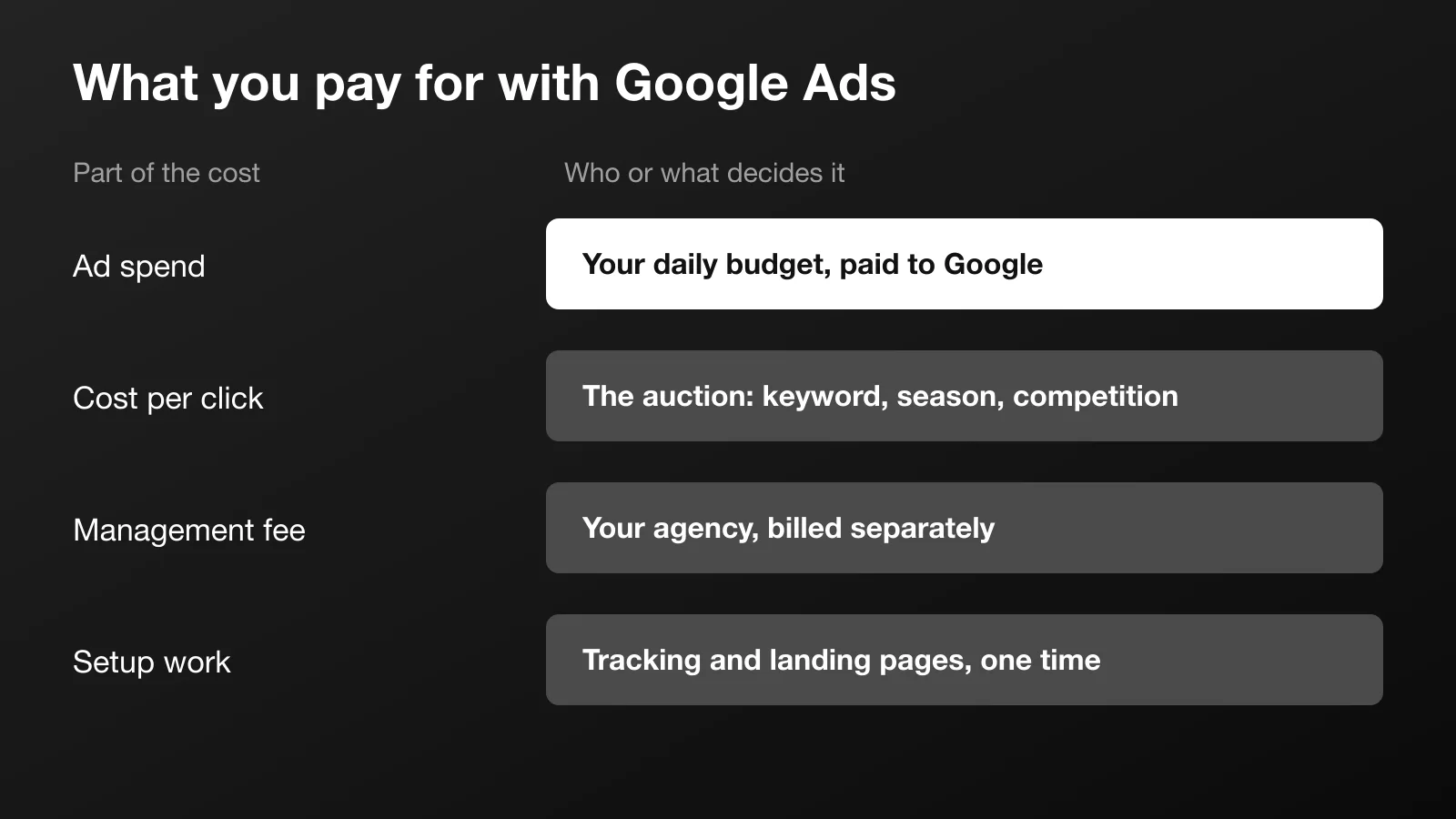
A management quote is easy to compare when it lists the same things. Ask each one to write down:
- What setup includes: conversion tracking, landing pages, ad copy
- How many campaigns they will run, and for which trips or room types
- How often they review the account, and what they change
- What the monthly report shows
- The minimum term, and what happens to the account if you leave
We don't publish fixed prices because the work differs a lot between a single hotel and an operator selling ten packages across three seasons. Send us your details and we will give you a written quote with this list filled in.
Track calls, WhatsApp and forms before you spend
Without tracking you are judging ads by clicks, and a click is not a guest. Set up conversion tracking for every way a person can reach you:
- Forms. Count an enquiry when the thank-you message or page appears, not when the form opens.
- Calls. Use call assets so people can ring from the ad, and track taps on the phone number on your website.
- WhatsApp. Count clicks on the WhatsApp button as a conversion. Add a short reference line to the prefilled message so your team can see the chat came from an ad.
- Bookings. Mark which enquiries became bookings in your CRM or sheet. Later, these can be sent back to Google so it learns which clicks turn into paying guests.
Start small, then judge cost per enquiry and cost per booking
Your first campaign should be boring. One or two of your best-selling trips or room types, the cities your guests come from, and one landing page for each. Pick a daily budget you are comfortable treating as the cost of learning, and give it a few weeks before you judge it. Changing everything every two days tells you nothing.
Then work out two numbers:
- Cost per enquiry: ad spend divided by real enquiries, meaning people who called, wrote on WhatsApp or filled a form about a real trip or stay.
- Cost per booking: ad spend divided by the bookings that came from those enquiries.
The second one is what matters. Compare it with your margin on a booking, not the booking value. A hotel can also compare it with the commission it would have paid an OTA for the same room. If cost per enquiry is fine but cost per booking is high, the ads are working and the follow-up or the price needs attention.
Negative keywords stop paying for the wrong searches
Google will show your ad for searches you never thought of. Some of them waste money every day. Check the search terms report every week and add negative keywords for anything that can't become a booking. Common ones in travel:
- jobs, vacancy, salary, hotel management course
- free, pdf, wikipedia, news
- registration, if people are looking for the official yatra portal and you don't help with it
- names of places or services you don't offer
Most of the waste we see in Google Ads for hotels and tour operators comes from searches like these. A few weeks of weekly checks usually cleans up a campaign more than any change to bids.
Location and schedule settings
Location. Target where your guests live, not where your hotel is. A Char Dham operator may sell mostly to families in Delhi NCR, Gujarat and Maharashtra. A Mussoorie hotel might want people in Delhi and Chandigarh, plus people who show interest in Mussoorie itself. Google lets you choose between people in a place and people interested in it, so pick deliberately.
Schedule. If your ads invite calls, run them when someone can answer the phone. At night, you can lower bids or lean on WhatsApp and forms, with an auto-reply that says when you will call back.
If you are deciding between platforms first, read Google Ads or Meta Ads for a Dehradun business.
Getting help
We run Google and Meta ads for hotels and tour operators from Dehradun, with tracking set up before any money is spent and ad spend billed separately from our fee. We can't promise a fixed number of bookings, and you should be careful with anyone who does. If you would like a quote or a second opinion on an account you already run, get in touch.

 WhatsApp