

Hotel SEO checklist for India: the work that brings direct bookings
By AnyInfraTech Team ·

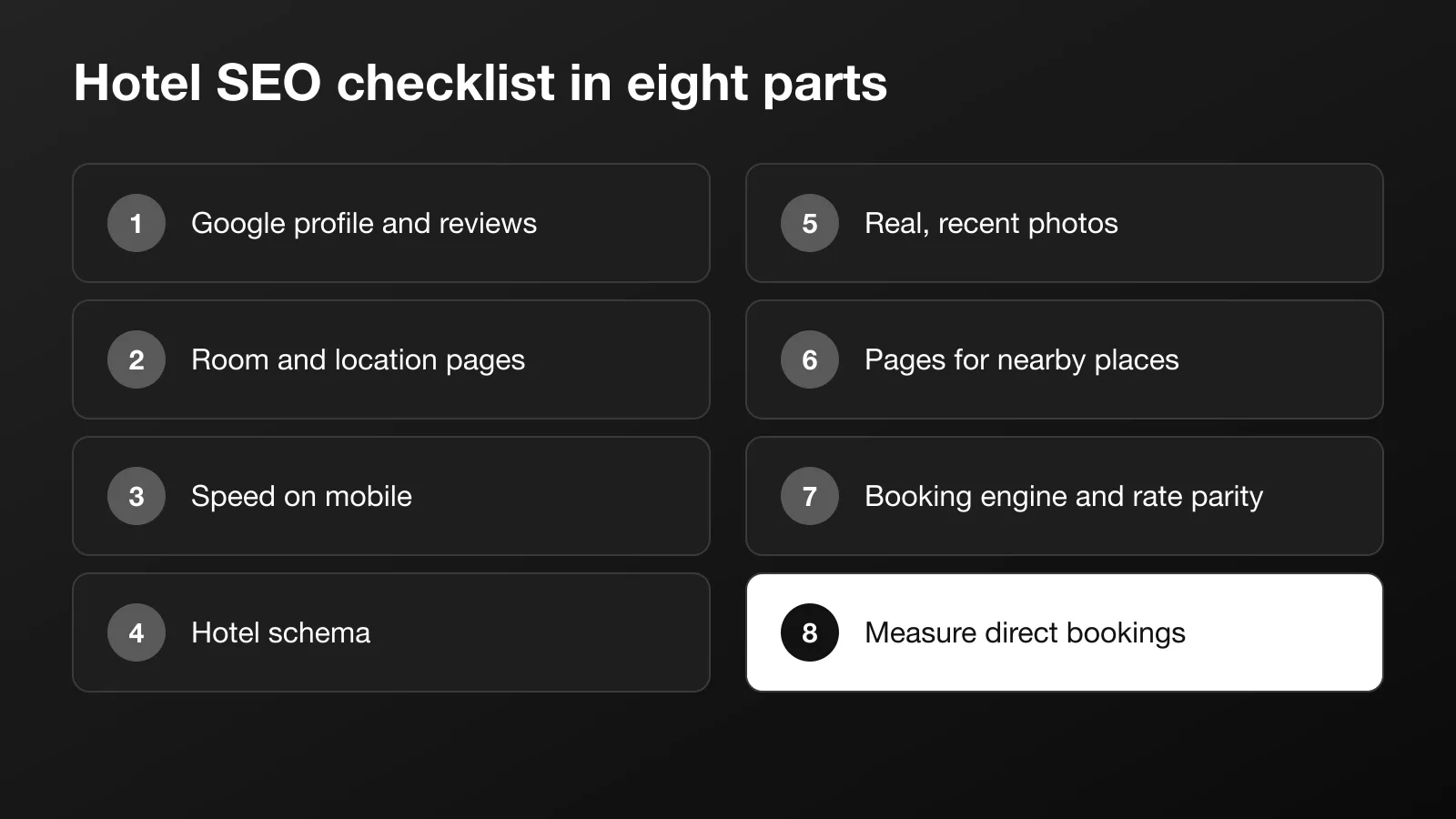
Most hotel owners who ask us about SEO want one thing. They want more guests to book on their own website and fewer through the OTAs. Rankings only matter if they lead there. This hotel SEO checklist is written for small and mid-size hotels, resorts and homestays in India, and it is in the order that usually brings a booking soonest.
We do SEO for hotels in Uttarakhand and run hotel booking platforms of our own, so most examples here come from Haridwar, Rishikesh, Mussoorie and the Char Dham route. The same steps work for a hotel in Jaipur, Goa or Manali.
First, search your own hotel's name
Before any keyword research, pick up your phone and search your hotel's name on Google. Look at what a guest sees.
If the top results are OTA listings and your own site comes fourth, you are paying commission on guests who already knew who you were. Fixing that is the cheapest win in hotel SEO, and most of the checklist below helps with it.
1. Google Business Profile and reviews
For a hotel, the Maps listing often brings more enquiries than the website does. Get these right:
- The most accurate primary category. Hotel, resort, guest house and so on. Pick what you are, not what sounds bigger.
- The website button goes to your own site. Not an OTA page, and not a social media profile.
- A phone number someone answers, plus check-in and check-out times, amenities and parking.
- Fresh photos every month. Rooms, bathrooms, the view, the dining area and the road in.
Reviews need a system, or they won't happen. Ask every guest at checkout, with a QR code at the front desk and a short WhatsApp message after they leave. Reply to every review, the bad ones most of all, because the next guest reads your reply more carefully than the complaint. Don't buy reviews, and don't offer a discount in exchange for one. Google's review policies don't allow either.
Our Google Business Profile guide for hotels and tour operators covers the full setup.
2. One page for each room type, and a real location page
A single "Rooms" page with six photos can't rank for much. Give each room type its own page with:
- Size, bed type, how many people it sleeps and whether an extra bed is possible
- The view, the bathroom and what is in the room
- A starting rate, or at least what changes the rate
- A clear book or enquire button
Then build a proper location page. Distance from the railway station, bus stand and airport. How far the ghat, temple or mall road is on foot. Where guests park, and whether the last stretch is steep or narrow. Pilgrims and families search for exactly this: "hotel near Har Ki Pauri with parking" is a real kind of search, and a page that answers it in plain words can rank.
3. Page speed and mobile
Most hotel searches in India happen on a phone, and in the hills the signal is often weak. A page that takes too long to load loses the guest to the OTA app.
Run your home page, room pages and booking page through Google's PageSpeed Insights. The usual problems on hotel sites are the same every time:
- Huge slider images that were never compressed
- Autoplay background videos
- Chat widgets and booking scripts loading on every page
- Phone and WhatsApp buttons that are hard to tap
Fix these first. Google's Core Web Vitals report in Search Console will show which pages are still slow for real visitors.
4. Hotel schema
Structured data tells Google, in a format it reads easily, that this page is about a hotel at this address. Use the schema.org Hotel type (or Resort, or the wider LodgingBusiness) and fill in the name, address, map coordinates, phone, check-in and check-out times, amenities and photos.
Two rules. The details must match your Google Business Profile word for word. And don't mark up reviews of yourself on your own site, since Google doesn't show review stars for that. Test the page with Google's Rich Results Test after you add it.
5. Photos that sell the room
Photos do more for a booking than any line of copy. Use real, recent photos, not stock images of a lake you can't see from the property.
A few habits help with search as well:
- Save files in WebP and keep them small enough to load fast on mobile data
- Give files sensible names like "deluxe-room-ganga-view.webp" instead of "IMG_4471.jpg"
- Write a short alt text that says what is in the photo
- Show the things guests worry about: the bathroom, the stairs, the parking, the view from the window
Put your best set on your own website. If the OTA listing has better photos than your site, guests will trust the OTA more.
6. Local pages around attractions and yatra routes
Many guests search for the place first and the hotel second. "Stay near Lakshman Jhula", "hotel in Guptkashi for Kedarnath", "where to stay before Gangotri". If you only talk about your own rooms, you miss all of these searches.
Write a few useful guides about what is around you. How far each place is, the best time to go, how long to keep for it and how to get there. For hotels on the Char Dham route, night-halt planning is where pilgrims need help most: which town to stop in before each dham, and how early to leave.
Keep it honest. One good page for each place you really serve beats forty copied pages with only the town name changed. Google treats that pattern as doorway pages. Our SEO services in Uttarakhand page explains how we plan these long-tail pages for local and travel businesses.
7. Booking engine and rate parity with OTAs
SEO brings the guest to your site. Your booking engine has to close the sale. A site that only says "call us" loses the guest who is planning at 11 pm.
You need live availability, a clear rate, online payment by UPI or card, a pay-at-hotel option if you offer one, and an instant confirmation on WhatsApp and email. We build this on our hotel booking engine for Uttarakhand, and the same checklist applies to any engine you choose.
Then check rate parity every week. Open the OTA on a phone while logged out and compare its price for the same room and date with your own site. If your site is more expensive, the guest goes back and books there. Keep your direct rate at least equal, within what your OTA contracts allow, and add the benefit in extras: breakfast, early check-in, a puja arrangement, a free cancellation window. We wrote more on this in how hotels in Uttarakhand can win more direct bookings.
Also ask your booking engine or channel manager whether it connects to Google's hotel prices. If it does, your own rate can appear next to the OTA rates when people search for your hotel.
8. Measure bookings, not traffic
Traffic is easy to grow and easy to misread. A blog post about Kedarnath weather can bring thousands of visits and no bookings. Track the numbers that lead to money:
| What to track | Where to see it | What it tells you |
|---|---|---|
| Direct bookings from organic search | Booking engine and Google Analytics | Whether SEO is paying for itself |
| Calls, direction requests and website clicks | Google Business Profile performance | Whether the Maps listing brings real guests |
| Clicks on searches for your hotel's name | Search Console | Whether your site or the OTA wins your own name |
| Clicks on room, location and attraction pages | Search Console | Whether long-tail pages are being found |
| Direct bookings as a share of all bookings | Your booking register, monthly | The number you are working to move |
For phone and WhatsApp bookings, ask every guest how they found you and note it. A simple column in your register is enough.
Choosing an SEO agency for hotels
If you hire a hotels SEO company in India, ask three things before you sign. Will the Google Business Profile, Search Console and Analytics stay in your name? Do they understand booking engines and OTA rate checks, or only blog posts? Will the monthly report show bookings and enquiries, or only rankings?
Anyone who promises the first position on Google for "hotels in Rishikesh" is guessing at best. No one can guarantee that.
A hotel SEO plan in five steps
- Fix your name search and your Google Business Profile.
- Build room and location pages, fix speed and add hotel schema.
- Get the booking engine and rate parity right.
- Write attraction and route pages before the next season.
- Keep collecting reviews and photos, and check the numbers every month.
Good SEO for hotels in India is mostly steady, practical work done in the right order. If you would like us to go through this checklist with your property, see our SEO service. We start with an audit, tell you what to fix first, and report on bookings as well as rankings.

 WhatsApp